“Who else has data from our territory?” Working with the Wayana on biodiversity data
“Who else has data from our territory?” Working with the Wayana on biodiversity data
By Rudo Kemper, Director of CMI’s Indigenous Guardianship Program
Sometimes a very specific question from a partner opens up a much bigger area of work.
That happened this week with the Mulokot Foundation in Suriname. What started as a conversation about iNaturalist turned into a broader exploration of biodiversity data from the Wayana Territory: where it goes, who holds it, who has collected it, and how communities can have greater visibility and control over it.
It also became a good example of how we work at Conservation Metrics: a combination of advisory support, hands-on technical accompaniment, and tool building, all emerging from concrete partner needs.
From iNaturalist to Guardian Connector
As part of their ongoing biocultural monitoring work, Mulokot has been using iNaturalist to collect biodiversity observations in the Wayana Territory and plans to continue using it during an upcoming citizen science expedition in October with Echo Echo & Taxon Expeditions, a Dutch research institute.
We had been talking with Mulokot about the implications of using a platform like iNaturalist from a data sovereignty perspective. In this case, they were comfortable with these particular observations being public because the species they were documenting were not considered sensitive.
While looking through the data together, we noticed that some of the observations had also appeared on GBIF, the Global Biodiversity Information Facility. So we started digging into how that happens.
We found that licensing is part of the answer. Research-grade observations on iNaturalist can be incorporated into GBIF when they are published under compatible licenses. That led us into a useful discussion about the relationship between the two platforms, and how a decision made when publishing data in one place can affect where that data ends up later.
CMI has already recently built an iNaturalist connector for Guardian Connector, our private data integration and monitoring platform co-created together with Nia Tero, who is also a key funder of the platform, and over a dozen of its Indigenous community organizations across the world.
We helped Mulokot pull iNaturalist observations into their own Guardian Connector data warehouse and set it up so that new observations will continue to sync automatically. But going through the data also showed us something we needed to improve. We realized that we were not pulling in the metadata that says whether an iNaturalist observation has reached “Research Grade” status. Given that this status matters for how observations can move into GBIF, that was clearly something the connector should include.
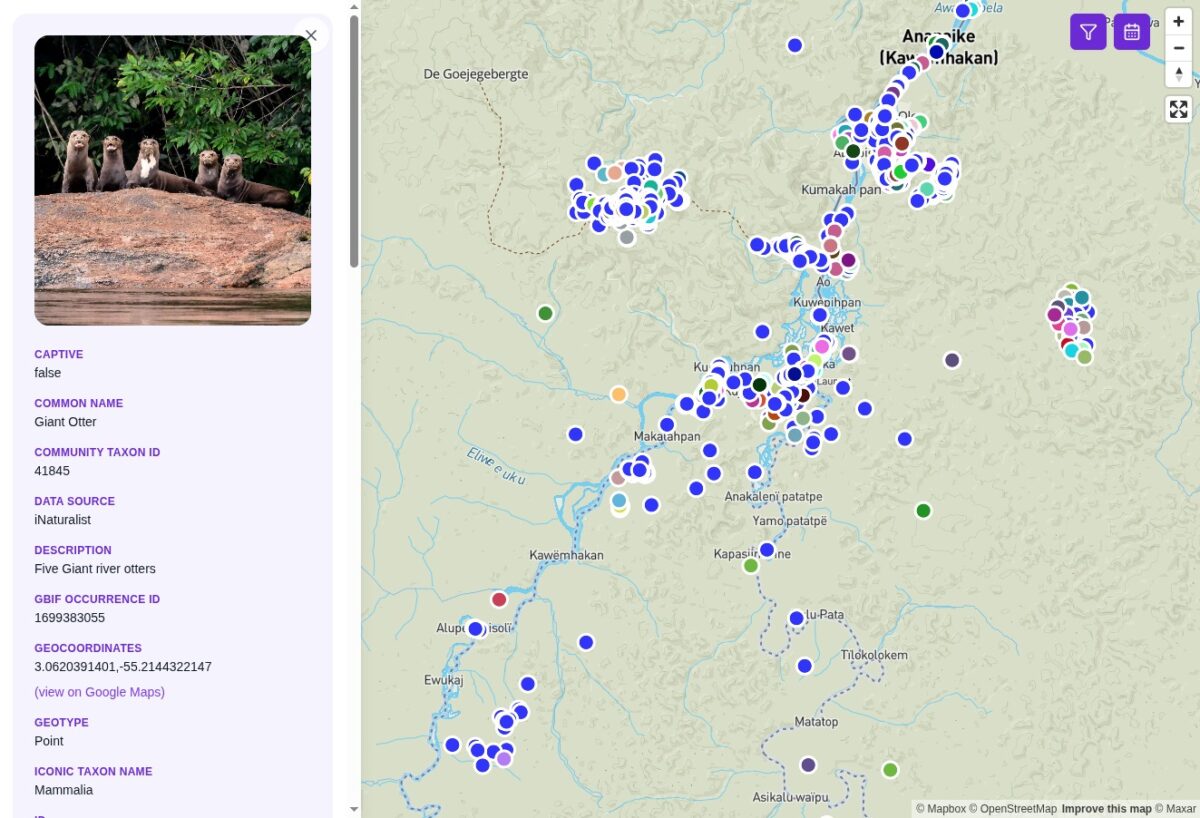
INaturalist data from across Wayana territory, stored and visualized in Mulokot’s Guardian Connector.
So even at that stage, the work was doing two things at once: helping Mulokot bring their data into their own infrastructure, while also showing us how the Guardian Connector integration itself needed to improve.
Then the GBIF discovery led to a bigger question.
“Who else has our data?” Enter GBIF
Mulokot’s slogan is “Nothing About Us, Without Us.” That made the next question in relation to this work pretty obvious:
What other biodiversity data from the Wayana territory is already out there?
Who has collected data there? What species were they documenting? Which institutions hold those records? How old are they? Are they attributing the Wayana as knowledge holders, at all?
We tried to answer that through the existing GBIF interface, but it was not especially easy to get a clear territory-level picture. So we built a small tool to make it easier.
The result is the GBIF Map Search tool, here you can upload a territory boundary or define an area on a map and search GBIF for biodiversity records that fall inside it. It returns information on datasets, publishers, species, records, and collection dates.
When we shared the results with Mulokot, there was a lot more data than we expected. The records came from a range of institutions and collectors, and some went back to the early 1900s. That was interesting in a very practical way. Suddenly you could see a history of biodiversity research in the Wayana Territory that had been spread across different institutions and databases for decades.
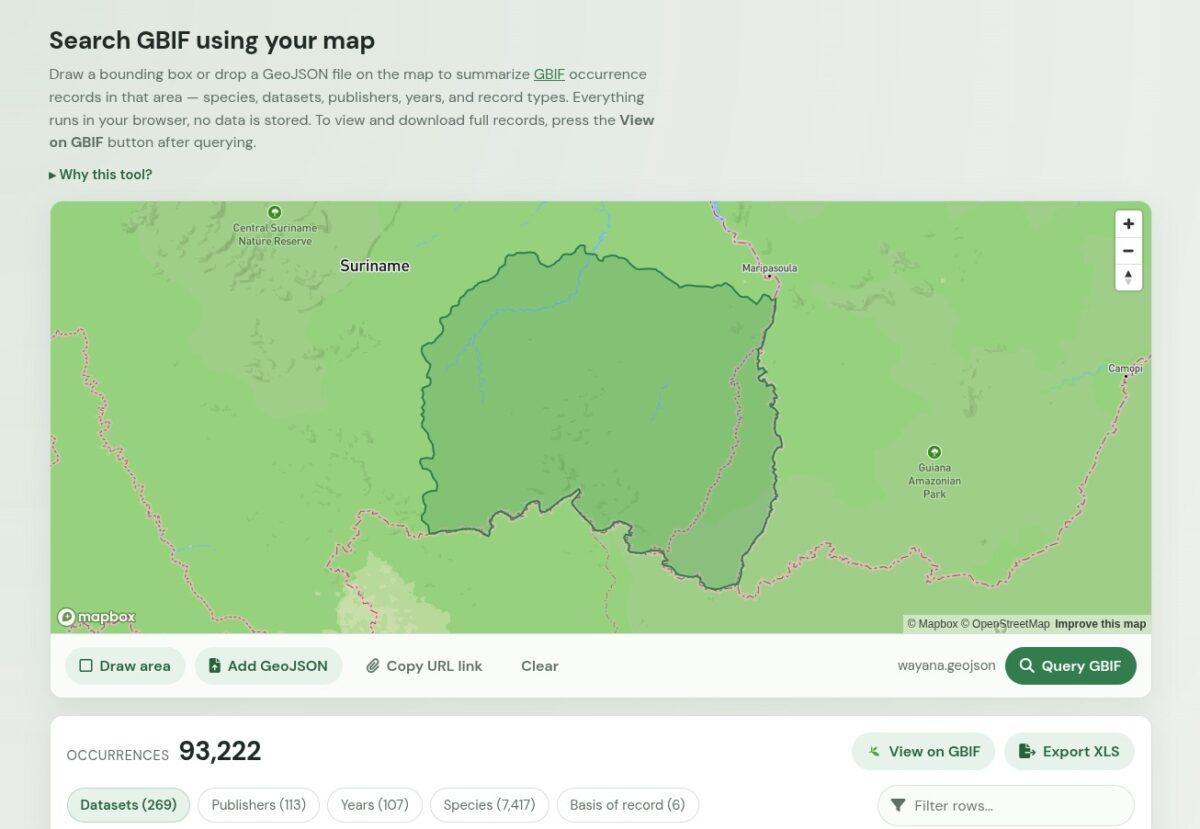
Wayana territorial boundary used to query GBIF
Turning one partner question into something reusable
Abram Fleishman, Director of CMI’s Science program, and I started thinking that this was unlikely to be a question unique to Mulokot. Many community organizations may want to know what biodiversity information has already been collected from their territories, particularly when thinking through questions of data governance, research relationships, culturally sensitive species, or future monitoring work.
So, we looked into how the underlying GBIF records could be downloaded, and our new lead software engineer Brendan McGill added a connector script to our growing library of data connectors to pull GBIF data from within a territory directly into Guardian Connector.
We also realized that a lot of what we were learning about iNaturalist and GBIF was not especially obvious if you do not work with these systems regularly. There are questions around Research Grade status, licenses, what gets shared downstream, and how records can be accessed again later.
Therefore, we documented what we learned. The Guardian Connector documentation hub is an important part of making these tools and processes more accessible to Indigenous and community partners, bringing together practical training materials with guidance on more nuanced issues such as data governance, ownership, and sovereignty. As part of this work, we published two new guides in the Guardian Connector documentation hub: one on community use of iNaturalist and another on GBIF. They cover how the platforms work, some of the considerations for Indigenous and community organizations using them, how data moves between systems, and how data can be accessed or exported. The GBIF guide also links to the map search tool.
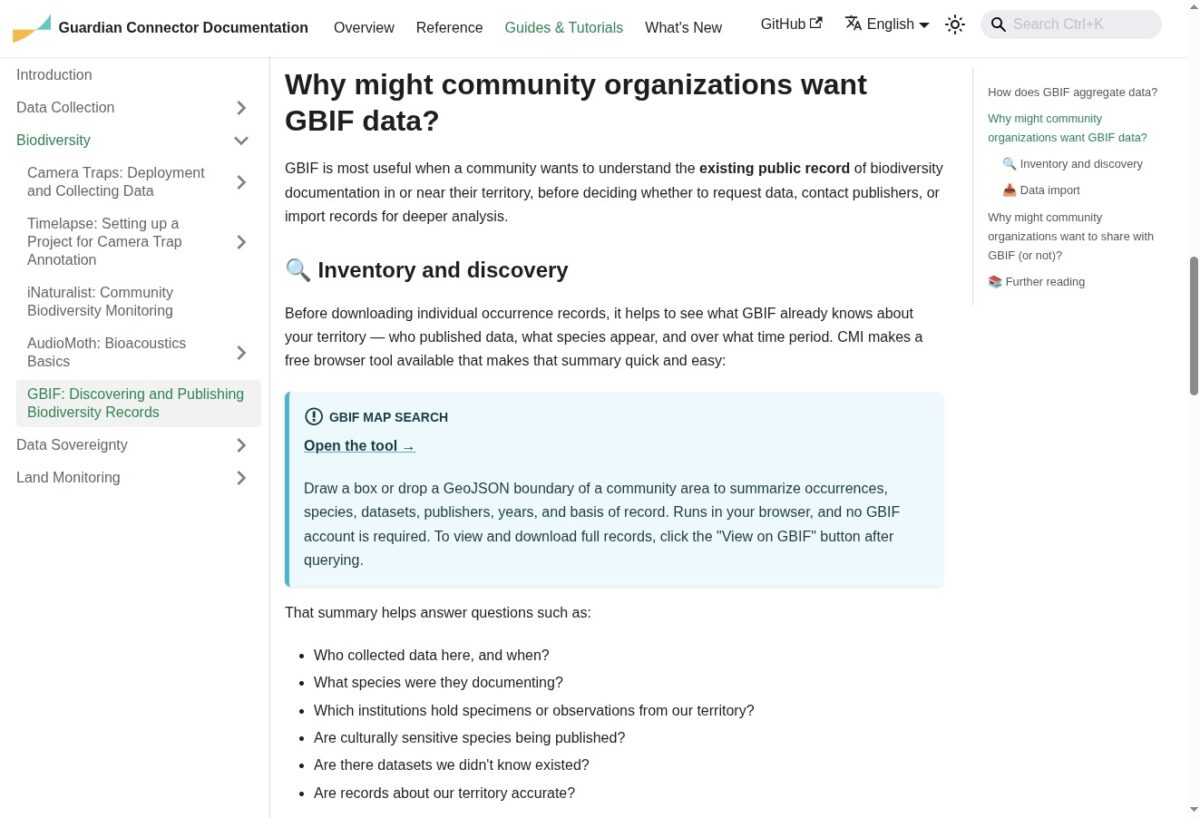
Guide on Guardian Connector documentation about Indigenous community use cases for GBIF
Within a few days, one conversation with Mulokot had turned into several different pieces of work: support to Mulokot around how their biodiversity data is being shared, an improvement to the Guardian Connector iNaturalist integration, a new GBIF territory search tool, and two guides that can now be used by other organizations.
This is exemplary of how we think about scaling and replicating our work. We are not trying to solve the same problem separately for every organization. A partner comes to us with a particular question or need. We work through it with them; and, if part of what we learn can be turned into a better integration, a reusable tool, or documentation that helps the next organization, we do that too.
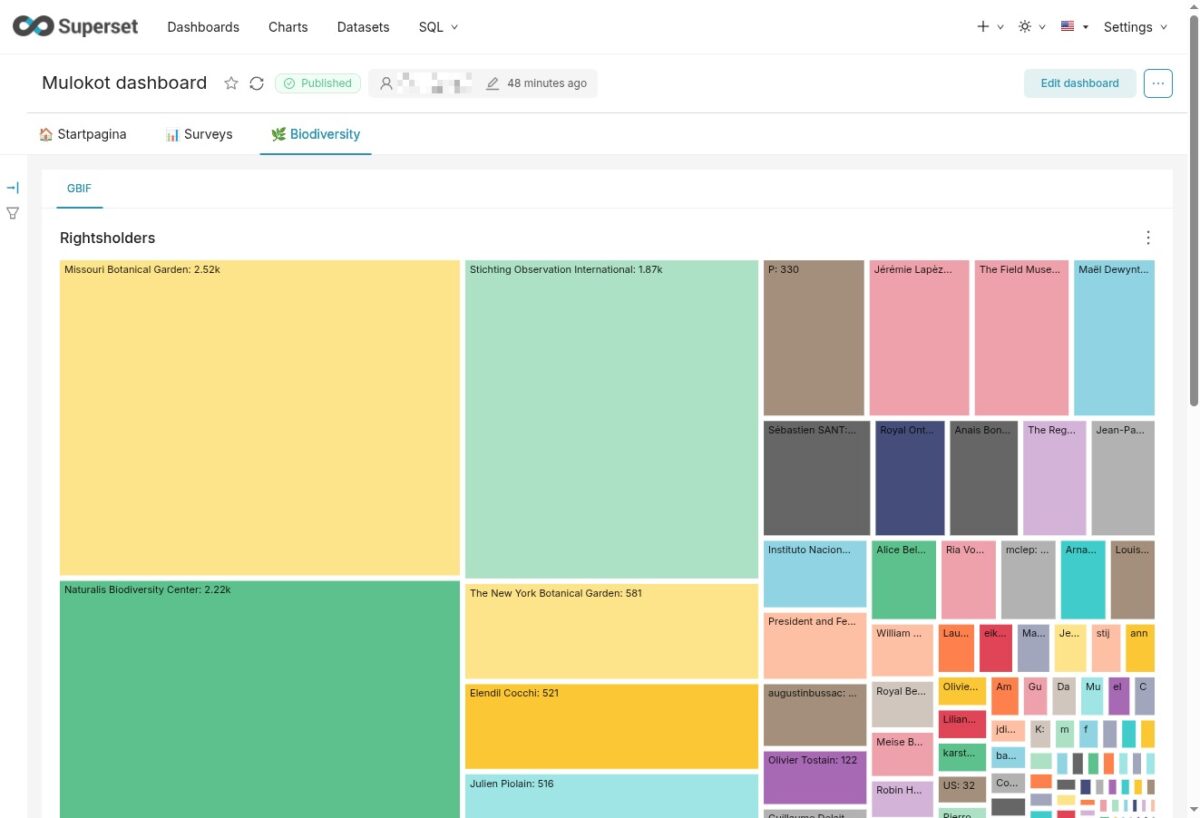
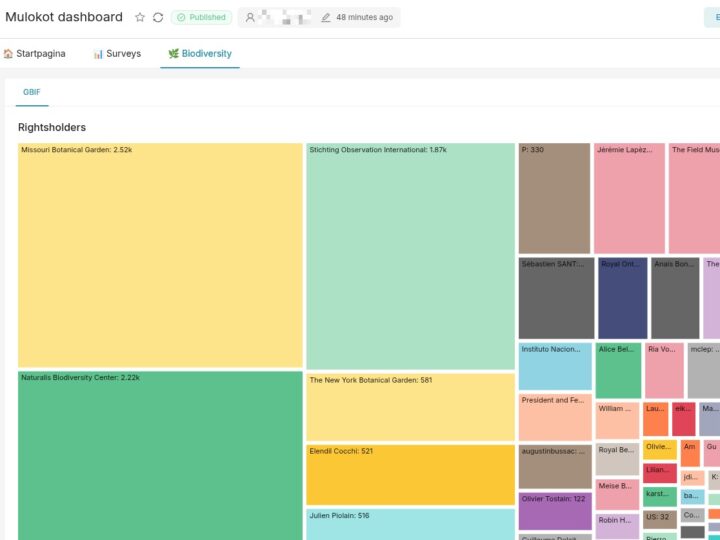
GBIF data analyzed on Mulokot’s Guardian Connector dashboard, showing the rightsholders of more than 90,000 biodiversity occurrences
Supporting communities to decide how their data travels
There is one more piece we are now looking at. We want communities using Guardian Connector to be able to take biodiversity data in their own systems and export it using Darwin Core, the widely used data standard for exchanging biodiversity information. To support this process, we have already integrated with Local Contexts, an initiative that provides customizable Traditional Knowledge and Biocultural Labels that communities can use to communicate their own protocols, expectations, and rights around the use of data and knowledge.
For Mulokot, the ability to build and maintain this body of data under their own control has particular significance. Suriname remains the only country in South America that does not legally recognize Indigenous Peoples’ collective rights to their lands and territories. Building a record of biodiversity, monitoring, and stewardship in the Wayana Territory can help Mulokot document their ongoing guardianship of the territory and support their own efforts to advocate for recognition of their collective territorial rights.
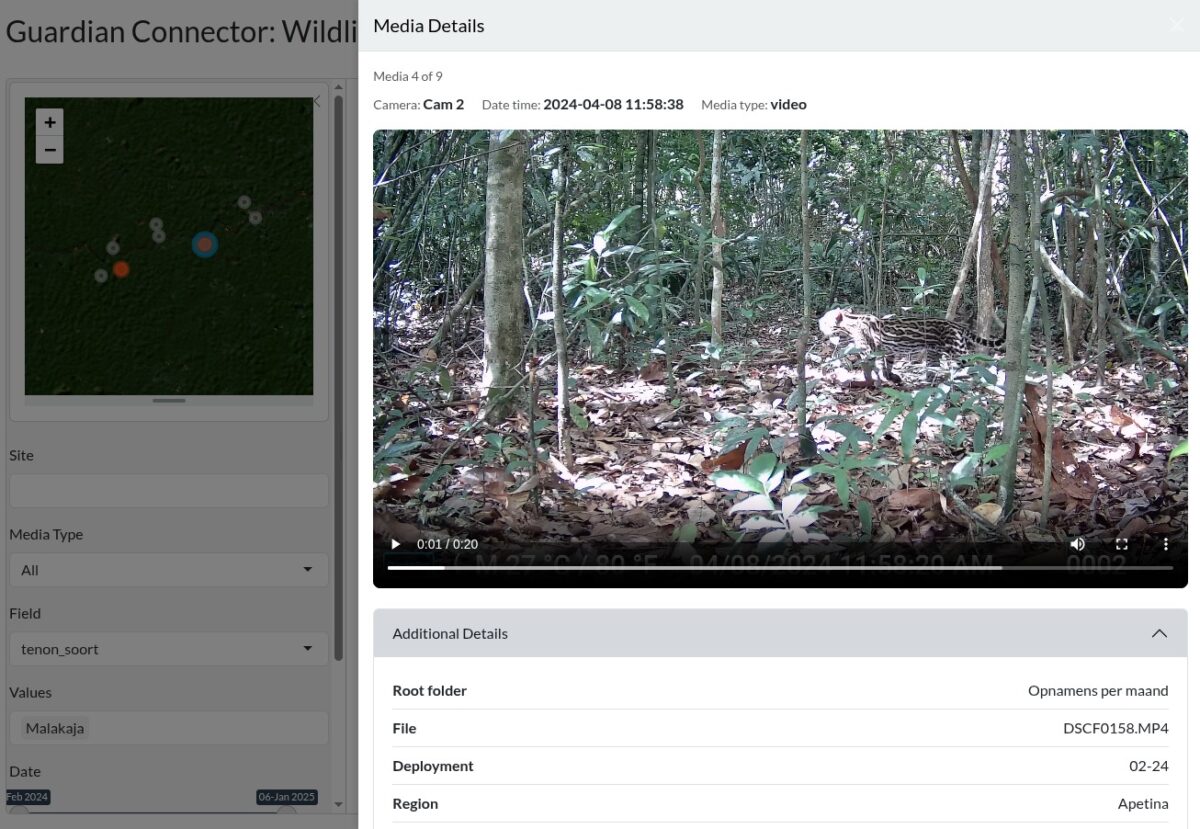
Camera trap data collected by Mulokot shown in a new Guardian Connector interface designed for biodiversity data, originally co-created with the Chepkitale Indigenous Peoples’ Development Project in Kenya
For Mulokot and other community-based organizations, that could mean keeping and organizing biodiversity observations inside infrastructure they control, while still being able to export those records in a format that can be shared with researchers, biodiversity databases, or other systems if they decide to do so. That part matters because the goal is not to keep biodiversity data from ever being shared. It is to make sure communities know where their data travels, retain a copy within systems they control, and are the ones deciding when, how, and with whom it is shared.
All of this came out of a pretty ordinary conversation about a tool Mulokot was already using. That is often what the work looks like for us.
Conservation Metrics, Inc. works in partnership with the Mulokot Foundation via support from the Nia Tero Foundation.